Vapi vs Retell AI
The two platforms most teams shortlist for AI voice agents. We have shipped a production outbound voice product on a custom LiveKit pipeline, so we know exactly what these platforms abstract away, and when that abstraction is worth it.
Developer-first voice-agent platform
Voice agents for sales and support teams
Our honest call, even the part we don't sell.
Both are credible ways to get a working AI voice agent this week. Vapi is the developer-flexible option: bring your own models, wire webhooks and tools, tune the pipeline. Retell leans into the contact-center use case: agent flows, batch calling, and operational polish for sales and support teams. Prototype on whichever matches your team’s shape. The decision that matters more: both are per-minute platforms sitting on the same STT → LLM → TTS stack, so at real call volume the platform margin and the control ceiling become the story; that is when a custom pipeline on LiveKit or Pipecat starts paying for itself.
Bias disclosure: We build custom voice agents (our AI Calling Agent runs a LiveKit pipeline we own end to end), so we have a commercial interest in the "build custom" branch. The honest flip side: for prototypes and moderate volume, these platforms are the right call and we say so below.
The tradeoffs, laid bare.
| Dimension | VVapi | RRetell AI |
|---|---|---|
| Best fit | Developers building custom voice agents | Sales/support teams deploying calling agents |
| Abstraction level | Lower: pipeline knobs exposed | Higher: flows and campaigns |
| Model flexibility | Bring/swap STT, LLM, TTS providers | Curated providers, less swapping |
| Tool calling & webhooks | First-class, developer-shaped | Supported, more opinionated |
| Outbound campaigns | Possible, more assembly | Built-in batch calling |
| Pricing shape | Per-minute platform fee + underlying model costs | Per-minute platform fee + underlying model costs |
| Latency tuning | Config-level control | Mostly handled for you |
| Ceiling | Platform limits & margins at scale | Platform limits & margins at scale |
| The custom-build alternative | LiveKit/Pipecat pipeline you own, no platform fee, full control | Same: worth it at volume or for bespoke behavior |
Developer-first voice-agent platform
- 01Developers are building the agent and want API-level control
- 02You want to swap STT/LLM/TTS providers per use case
- 03Custom tool-calling and webhook logic are core to the agent
- 04You are validating a voice product and speed matters more than margin
Flexibility means assembly: prompts, providers, and edge cases are yours to tune, and per-minute platform fees stack on top of the model costs underneath.
Voice agents for sales and support teams
- 01The use case is a contact-center pattern: outbound campaigns, inbound support
- 02You want conversation-flow tooling, not raw pipeline knobs
- 03Batch calling, transfers, and monitoring out of the box matter
- 04A less-technical team will own the agent day to day
More opinionated: the further your use case drifts from calling workflows, the more the guardrails become walls. Same per-minute economics at scale.
The parts that actually decide it.
What these platforms actually are
Every AI voice agent is the same pipeline: telephony in, speech-to-text, an LLM with your prompt and tools, text-to-speech out: with interruption handling ("barge-in") and latency management stitched through the middle. Vapi and Retell both sell that pipeline as a service, so you configure instead of build.
That is genuinely valuable. The stitching is where voice agents fall apart; we wrote a whole guide on building one that doesn’t, and the platforms have solved the table-stakes problems well.
Vapi: configure the pipeline
Vapi’s pitch is control without infrastructure: pick your transcriber, your LLM, your voice; wire tools and webhooks; tune interruption behavior. If your team thinks in APIs, Vapi feels like a well-designed backend you rent.
The cost of that flexibility is that quality is still your job. The platform hands you knobs, and the difference between a demo and a production agent lives in how you set them: prompt discipline, tool design, and relentless testing against real calls.
Retell: deploy the use case
Retell packages the same pipeline around contact-center jobs: conversation flows, batch outbound campaigns, call transfers, monitoring dashboards. For a sales team that wants an SDR agent dialing a list, or a support line deflecting tier-one calls, more of the product is already shaped like the job.
The trade is opinionation. If your agent needs behavior the flow model didn’t anticipate, you will feel the walls sooner than on Vapi.
The math that changes at volume
Platform per-minute fees are a margin on top of the STT, LLM, and TTS costs underneath. At prototype volume, that margin is the best money you will spend: it buys you months. At thousands of call-minutes a day, it becomes a line item worth engineering away.
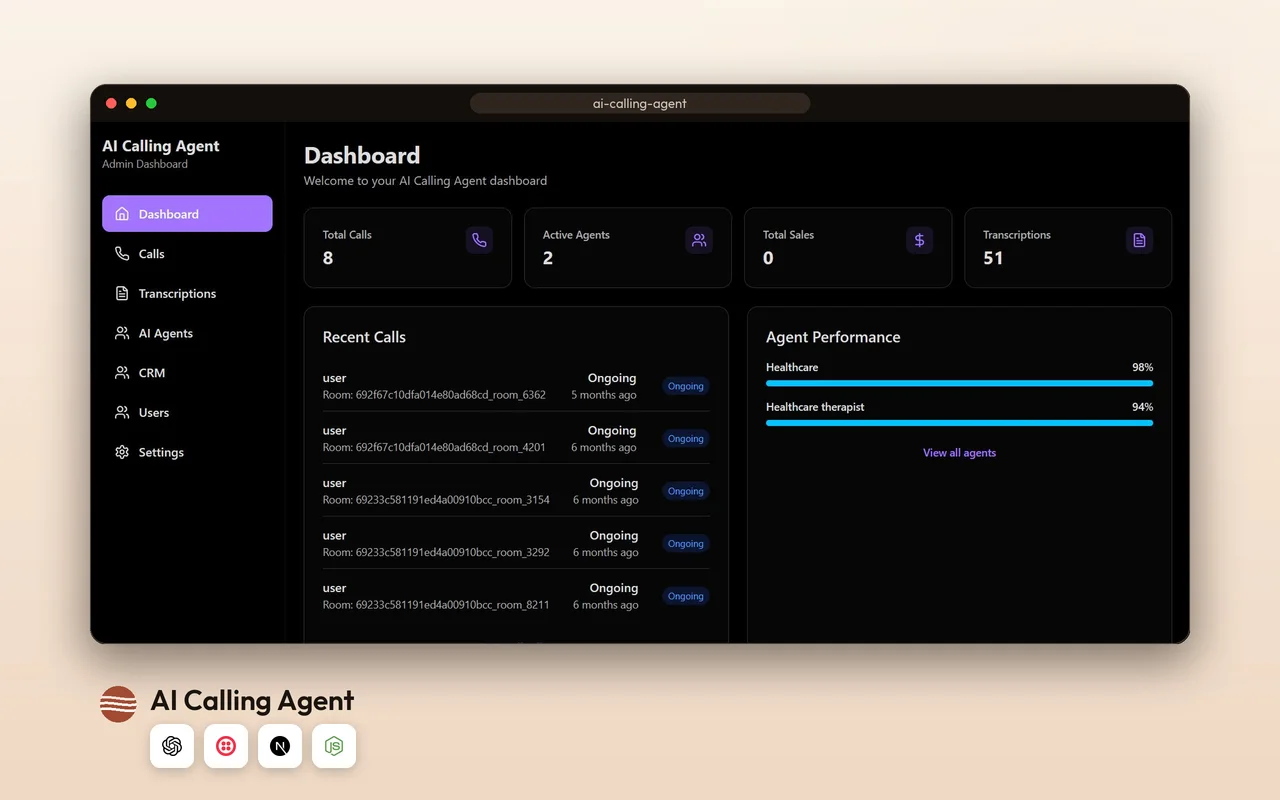
That is the point where a custom pipeline on LiveKit (what our AI Calling Agent runs) or Pipecat flips from over-engineering to obvious: you pay raw model costs, own the latency budget, and shape behavior the platforms cannot. Our rule for clients: prototype on a platform, and the day the agent proves revenue, start the custom-build conversation.
Proof, not promises.
Common questions.
Is Vapi or Retell better?
Vapi for developer teams that want pipeline-level control and provider flexibility; Retell for sales/support teams deploying calling workflows with less engineering. Both sit on the same underlying stack: pick by team shape, not benchmarks.
How much do Vapi and Retell cost?
Both charge per call-minute for the platform, and the underlying STT, LLM, TTS, and telephony costs stack on top (pricing changes often: check their pages for current numbers). The structural point: your cost scales linearly with talk time, which is exactly why high-volume products eventually build custom.
When should I build a custom voice agent instead?
When call volume makes the platform margin material, when you need behavior the platform cannot express, or when latency and voice quality are the product. A LiveKit or Pipecat pipeline costs more upfront and less per minute forever; that is the build we ship.
Do voice AI platforms work with any LLM?
Vapi lets you choose and swap LLM providers; Retell offers a curated set. Either way, the model matters less than the engineering around it: interruptions, tool calls, and fallbacks decide whether the agent survives contact with real callers.
Not sure which is right for your build?
Tell us what you're building and we'll give you a straight answer, even the one we don't sell.